Why Pool Filters Clog Quickly And How To Prevent It
A pool filter that keeps blocking every few weeks is almost never a faulty filter. It is a symptom of something upstream — unbalanced water chemistry, oils and sunscreen binding the media, a storm dump of organics, or cartridge that has reached the end of its useful life. Clean it and you fix it for a fortnight. Fix the cause and you fix it for a season.
The Short Answer: Why Your Pool Filter Keeps Clogging
The most common reasons a pool filter clogs faster than it should:
- High calcium hardness or pH scaling the sand or cartridge media so it never comes fully clean
- Sunscreen, body oils and lotions binding cartridge pleats into a greasy film a hose cannot shift
- Organic and debris load from the Gold Coast's storm season overwhelming the filter in a single afternoon
- Worn-out media — sand that has rounded off, or a cartridge past its service life
- Insufficient pump run time letting debris accumulate, then hitting the filter all at once
What Actually Causes a Pool Filter to Clog So Quickly?
The filter's job is to trap what the water carries. When it blocks faster than it should, the question is what the water is carrying and why.
Water chemistry is the most overlooked cause. High pH and high calcium hardness cause scale to form on sand grains and cartridge pleats. That scale resists a standard backwash or hose-down. You clean the filter, pressure drops for a week, then climbs straight back — not because the filter is dirty again, but because the scaled media is behaving as a partial blockage even when clean.
Sunscreen and body oils are a specific cartridge problem. Oily contaminants bind to the pleated fabric and form a film water cannot penetrate. A garden hose removes loose debris but not the greasy layer. The fix is a proper filter-cleaner soak — the step most owners skip entirely.
Under-running the pump compounds both issues. A pump running four hours a day in summer when eight to ten is appropriate leaves organics accumulating between cycles, so the filter receives a concentrated load rather than a steady one.
How Often Should You Clean or Backwash a Pool Filter?
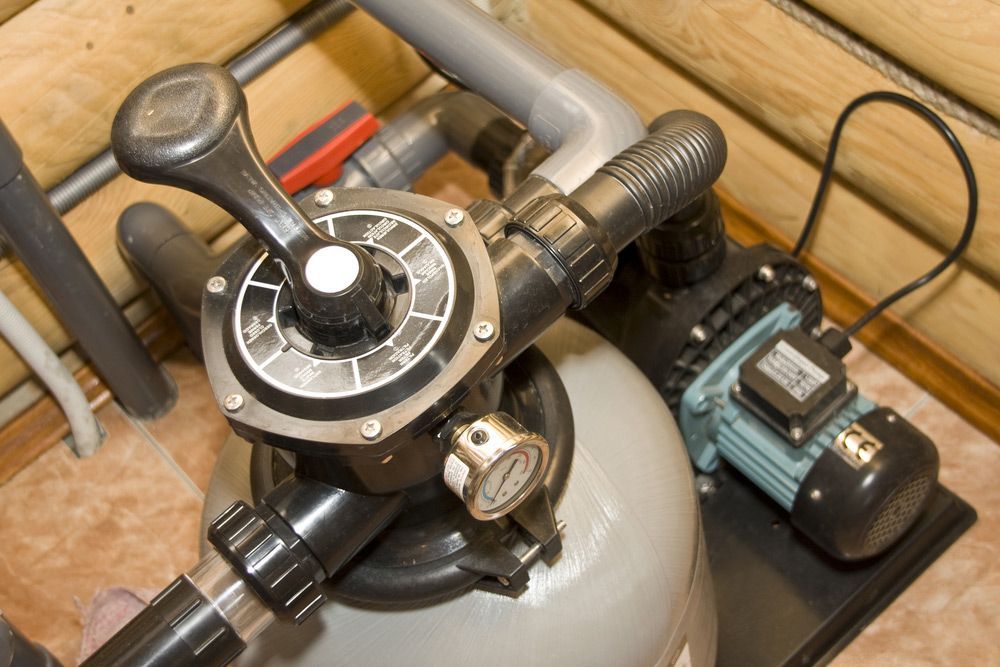
Use your pressure gauge, not a calendar. Note the pressure when the filter is clean — your baseline. General manufacturer guidance is to clean or backwash when pressure rises roughly 8 to 10 psi above that baseline. Check your unit's manual for the specific differential it recommends.
A pressure gauge that climbs again within days of cleaning points at chemistry or media condition, not dirt. More cleaning will not fix it.
Filter care is only half the system — our guide to keeping your pump and filter running efficiently covers the full picture.
Is It Your Filter or Your Water Chemistry?
If the filter blocks repeatedly despite regular cleaning, the water is the more likely cause. High calcium hardness and high pH together scale filter media consistently. Correcting both often resolves a chronic clogging problem without any new parts — a filter-cleaner soak strips existing scale, and balanced water prevents it reforming.
If pressure climbs again within a week of cleaning, bring a water sample to our
pool shop on the Gold Coast and we will test it before you spend money on a new cartridge. The test is free.
Cartridge, Sand or DE: Does Filter Type Change How Fast It Blocks?
Cartridge filters trap finer particles and use no backwash water, but clog faster under high load, require a chemical soak to clear oils, and the cartridge is a consumable. They are more sensitive to chemistry issues than sand.
Sand filters are forgiving under heavy load and simpler to clean via backwash. As sand ages, grains round off and channels form — water bypasses the media without being filtered. Pressure stays low, but the pool stays cloudy.
DE filters offer the finest filtration but require recharging with DE powder after each backwash. Less common in backyard pools.
When Should You Replace the Cartridge or Media Instead of Cleaning It?
Cleaning extends media life but does not restore it indefinitely. General guidance for typical residential use:
- Cartridges: every one to two years depending on usage and water chemistry. Replace when the cartridge remains discoloured after a chemical soak, has damaged pleats, or no longer returns pressure to baseline
- Sand: every five to seven years. Signs include pressure that does not drop adequately after backwashing, or persistent cloudy water despite good chemistry
If the filter housing itself is cracked or undersized, our
pool equipment installation service can assess and fit a replacement.
How Should Gold Coast Pool Owners Prepare Their Filter for Storm Season?
November to March on the Gold Coast can deliver a full season's worth of leaf litter and organics in a single afternoon. Pre-storm preparation makes the difference:
- Clean or backwash the filter before the storm, not after
- Empty skimmer and pump baskets beforehand
- Have a spare cartridge and O-ring set on hand — storm season is when parts run out
- Run an extended pump cycle after the event and monitor pressure daily
See the pool supplies you actually need for a full storm-season checklist.
FAQs